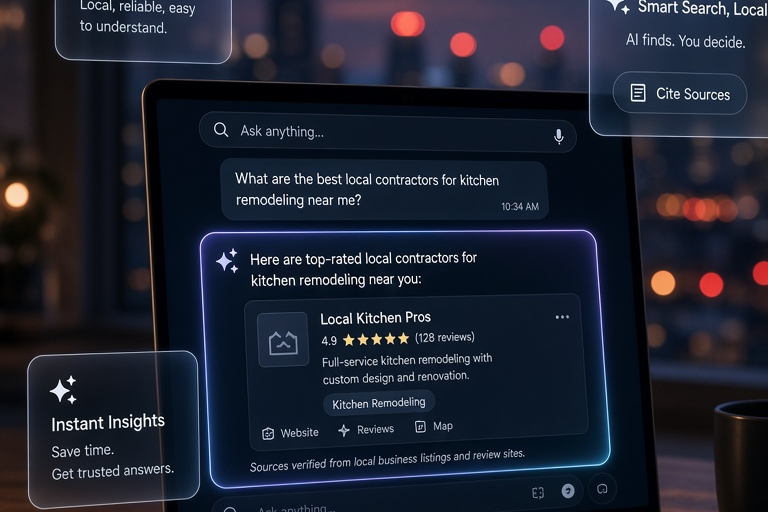
Google AI Overviews are generated from Google’s regular search index, not from a separate AI-only ranking system. To have a chance of being cited, your page needs to be indexed, written so it answers the question early, and specific enough to quote. Google has said no special AI-only markup is required.
What is a Google AI Overview?
An AI Overview is the generated summary Google sometimes places at the top of search results. It pulls from pages already in the index, compresses them into a short answer, and often names or links the sources it used.
That placement matters because many people never scroll to the blue links underneath. If your page is one of the sources, you can still earn the click — or at least be the business the summary mentions. If you are not, a ranking you used to own may get less attention.
AI Overviews do not appear on every query, and the format is still changing. Treat them as an extra layer on top of regular search, not as a replacement for it.
Do you need special markup to show up?
No. Google has said no special AI-only markup is required. INSITE ADVICE’s
AI SEO work starts with the same checks we already use for ordinary search: is the page indexed, can it show a snippet, and does it actually answer the query?
Structured data still helps when it is accurate. Schema should describe the business, the people, and the services exactly as the page does. It will not compensate for a vague or unindexable page, and conflicting markup can hurt more than it helps.
If you want the broader concept behind this — why generative engines pick some sources and ignore others — read our
guide to generative engine optimization. For how SEO, GEO, and AEO differ in language (and why we treat them as one plan), see
SEO vs. GEO vs. AEO: What’s the Difference?. The rest of this article stays with what to do for Google in particular.
What makes a page more likely to be cited?
The same qualities that make a page useful to a person make it easier for Google to quote.
Lead with the answer. If the query is a question, the first sentences should answer it. Supporting detail can follow. A long preamble about the industry, or a St. Louis landmark tour before the point, is a good way to be skipped.
Make passages quotable. A short, self-contained paragraph that states a fact, a process step, or a price range can be lifted into an Overview. A paragraph that only makes sense after three previous ones cannot.
Be specific. Names, locations, steps, dates, and prices are more useful than claims that you are “a leading provider.” If you publish a price range, say what it includes. If you serve St. Louis County and St. Charles County, say that.
Show who is responsible for the page. A named reviewer, an updated date, and evidence that can be checked all help a reader — and a model — decide whether the page is worth using.
How is this connected to regular SEO?
Closely. AI Overviews draw on the regular index. Pages that cannot be crawled, are not indexed, or are weakened by thin content, duplicate titles, or slow performance are poor candidates.
That is why
technical and on-page SEO still comes first. Fix indexing and cannibalization, tighten titles and headings so each page has a job, and make sure the content matches the query you want it to win. The same page-level habits also help when someone asks
ChatGPT for a recommendation.
Winning a classic blue-link ranking does not guarantee a citation in the Overview, and a citation does not always go to the number-one result. The practical stance is to do both jobs on the same page: rank for the query, and be the clearest source on it.
What about local searches in St. Louis?
For local questions, Google often blends the generated summary with local results that still depend on your Google Business Profile. Categories, services, hours, reviews, and a matching name, address, and phone number remain part of the picture.
We have already seen Google test variations of an AI local pack that summarize a business with fewer of the usual buttons. The profile is still the raw material. Keep it complete, and keep the same facts on your
local SEO pages. Our
Google Business Profile work exists for that reason, not as a separate trick for AI.
A St. Louis business should also write service pages that name the area it actually serves. An Overview about “who to call” in this metro will lean on pages that say so clearly.
How should you start?
Pick the questions that already bring you customers, or that you want to win. Search them and note whether an AI Overview appears, and which sources it names.
Then look at your own page for that question. Is it indexed? Does it answer in the first few sentences? Does it give facts a summary can use? Are two of your pages competing for the same query?
Change the pages that fail those tests. Confirm structured data is accurate. Wait, then check again. We re-test 30 to 60 days after changes go live, because Google refreshes generated results on its own schedule.
In October 2026, we ran this process on our own marketing consulting page, with a question a small business owner might ask about marketing help in St. Louis. Google’s AI Overview named INSITE ADVICE and cited that page. That is not a promise we can make for every query or every client. It is evidence that the same method we use on client sites is one we apply to our own.
How do you measure AI Overview visibility?
Search Console is the starting point for Google, including its generative AI performance reporting when it is available. Annotate anomalies. In mid-November 2026, Google confirmed a logging error that undercounted generative AI impressions for November 9 to 11, which is a useful reminder not to overreact to three days of data.
We also run a simple citation log: the same customer questions, asked on a schedule, with the cited sources recorded. Combined with ordinary ranking and lead data, that tells you whether the Overview is using your page, not just whether traffic moved.
A
free SEO audit can show whether the indexing and on-page basics are in place before you spend time chasing a generated box that your current pages are not ready to support.
FAQ
What is a Google AI Overview?
It is a generated summary Google sometimes shows at the top of search results, built from pages in the regular index and often accompanied by source links.
Do I need special AI-only schema to appear?
No. Google has said no special AI-only markup is required. Accurate structured data still helps when it matches the page. Indexing, a clear answer, and specific facts matter more.
Can an agency guarantee I will be cited in AI Overviews?
No. Google decides which sources to use and does not publish a formula. INSITE ADVICE can improve the page’s chances and measure whether citations change. We cannot promise a placement.
If I already rank number one, will I appear in the Overview?
Not necessarily. The Overview does not always cite the top classic result. The page still needs to be easy to quote and clearly on-topic.
Does appearing in AI Overviews replace SEO?
No. Overviews are generated from the same index that powers regular results.
SEO remains the foundation; AI SEO is how we prepare those same pages to be cited.
How often should I check whether I’m being cited?
Often enough to see a trend, not a single day’s result. We re-test 30 to 60 days after substantial page changes and compare the same question set each time.
If you want help preparing your pages for Google AI Overviews as part of a regular SEO plan, see our
AI SEO services or request a
free SEO audit.