
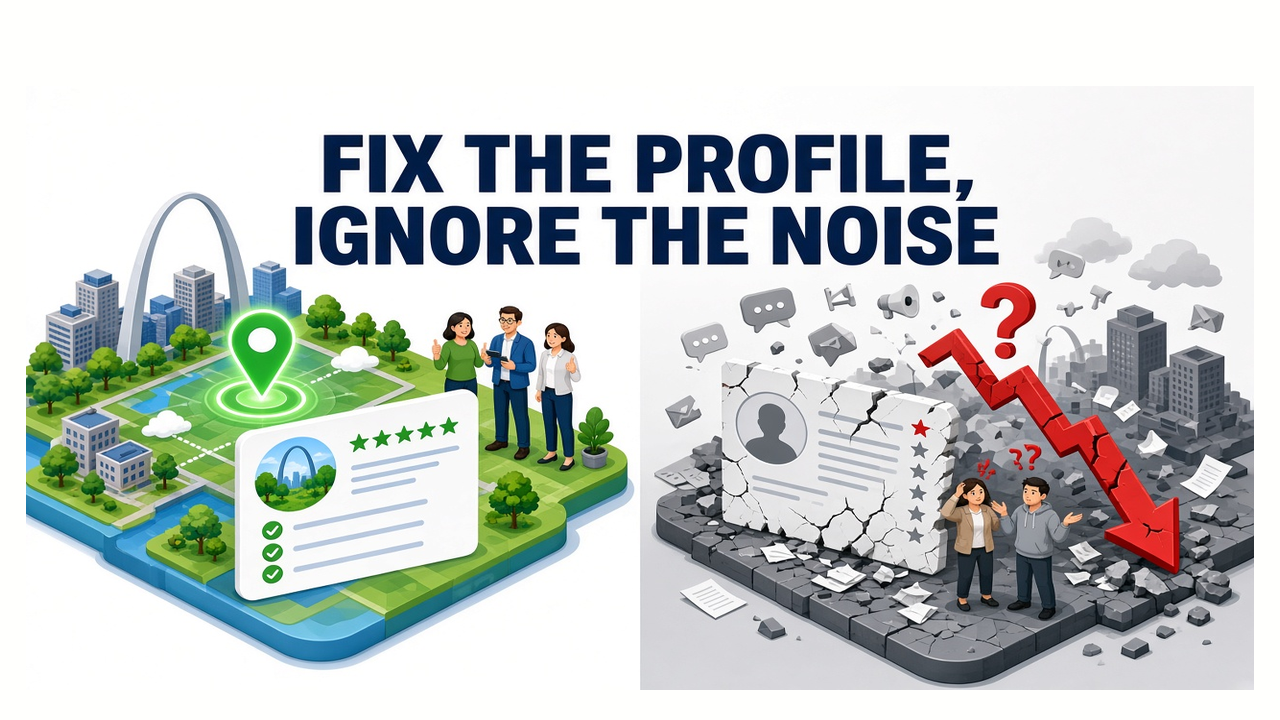
Monday, September 21, 2026. Morning landscape for St. Louis local business owners.
Google did not confirm a September core update. Rankings still moved. Here is what actually showed up in the last two weeks, and what a St. Louis owner should do before changing anything important.
1. September rankings are noisy. One week is not a diagnosis.
Search Engine Roundtable tracked an unconfirmed ranking blip around September 4 that reversed for some sites on September 13, then another chatter spike on September 15. Trackers lit up. Google's Search Status Dashboard listed no new confirmed September ranking update as of early September. The latest confirmed event remains the August spam update.
So what: If your St. Louis service pages dipped last week, do not rip out categories, rewrite your Google Business Profile name, or buy a panic citation package. Pull Search Console and call data from August 18 onward. Compare map-pack queries to organic pages separately. Fix what broke. Ignore the rollercoaster.
2. The August spam update still explains a lot of "sudden" losses.
SE Ranking's analysis of Google's August 18 to 21, 2026 spam update found 16.71% of URLs that ranked in the top 10 fell beyond position 100 for the same keyword, versus 9.2% in a similar five-day stretch in July with no confirmed update. That is about an 82% jump in severe dropouts across 20 industries.
So what: Thin service pages, spun city pages, and doorway-style location content are the usual suspects after a spam pass. If a St. Louis page lost organic visibility and never recovered, tighten it: one clear service, real proof, accurate NAP, and no copy-paste metro clones. Map-pack swings and organic spam hits are different problems. Treat them that way.
3. Researchers mapped 72 Google Maps entity signals. It is not a cheat sheet.
On September 8, Search Engine Land published reverse-engineered analysis of Google Maps architecture, including an internal Geostore ranking vocabulary called Oyster Rank with 72 signals. Reported concepts include reviews, web query volume, listing impressions, listing opens, direction requests, site clicks, chain membership, popularity, and prominence. Twenty-five signals were marked deprecated. The researchers are clear: this is not a published Maps formula and it does not include weights.
So what: Stop hunting for a 72-item hack list. Google still needs a clean entity: correct name, address, phone, categories, hours, and real engagement. For St. Louis multi-location or service-area businesses, keep every listing consistent and earn direction requests and site clicks from people who actually need you.
4. Complete, specific Google Business Profiles still correlate with better ranks.
Whitespark studied 1.8 million Google Business Profiles across 4,209 categories. A five-point completeness index (website, description, hours, photos, claimed status) lined up with average rank moving from about 62 at score 0 to about 43 at score 5. Top-10 appearance rose from 4% to 13%. Specific primary categories also showed a higher top-10 rate than generic ones (about 12.5% versus 9.2%). Correlation, not a guarantee.
So what: This morning, open your profile and score yourself 0 to 5. Pick the most specific primary category that honestly describes the work. Add only relevant additional categories. Upload current photos. If your HVAC or dental listing still says "General contractor" or sits half-empty while Clayton and Kirkwood competitors are complete, that is free visibility you are leaving on the table.
5. Ask Maps got more agentic. AI recommendations remain selective.
On August 6, Google announced Ask Maps upgrades: agentic food ordering with partners such as Square and Toast, hotel and event discovery, conversational contributions, Personal Intelligence via optional Gmail connection, and a wider English rollout. Separately, SOCi's 2026 Local Visibility Index found ChatGPT recommended only 1.2% of nearly 350,000 analyzed multi-location brand locations, versus a 35.9% appearance rate in Google's local 3-pack. Gemini recommended about 11%, Perplexity about 7.4%.
So what: Customers asking Maps or chat tools for "best [service] near me" get answers from structured, consistent data. Keep hours, services, and attributes accurate so Ask Maps does not send someone to a closed shop. Diversify authentic reviews and citations beyond Google alone if you want a shot at AI shortlists. The map pack is still the denser opportunity for most St. Louis owners. Treat AI visibility as a second scoreboard, not a replacement.
Quick checklist for this week
1. Chart organic and map visibility from August 18 through today before you change strategy.
2. Score your Google Business Profile 0 to 5 on completeness. Fix anything under 5.
3. Confirm your primary category is specific and accurate. Remove junk secondary categories.
4. Spot-check one high-intent St. Louis query in Maps and in ChatGPT or Gemini. Note whether you appear and whether the facts are correct.
5. Reply to every open review and ask for a fresh one after each completed job. No incentives. No scripted star language.
Local search still rewards accurate profiles, useful pages, and recent proof from real customers. Volatility grabs attention. Consistency compounds.
INSITE ADVICE St. Louis Digital marketing